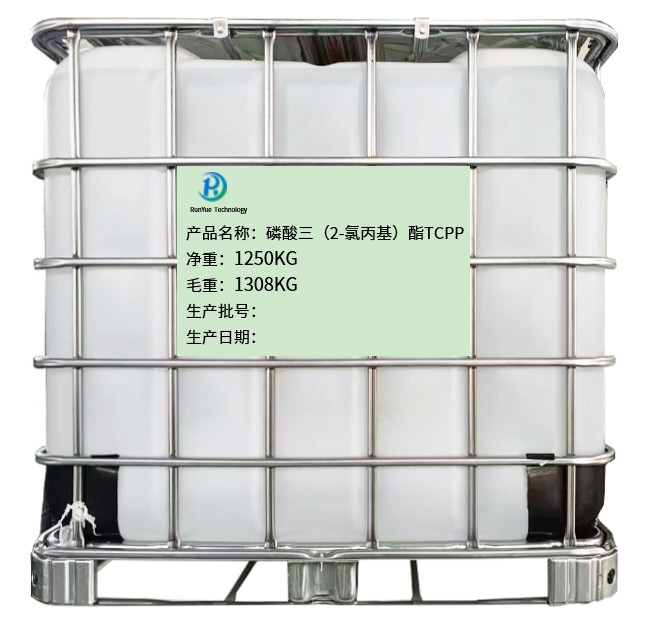
Understanding TCPP Flame Retardant and Its Role in Polyurethane Foam
For foam buyers, the phrase "TCPP flame retardant manufacturer in Shanghai" often appears in sourcing searches. Understanding what TCPP is and where it fits into foam formulations helps clarify what such a search term actually signals—and what it does not.
What TCPP (Tri(2-chloropropyl) Phosphate) Is and How It Is Identified
TCPP, chemically known as tri(2-chloropropyl) phosphate, is a phosphorus-based flame retardant with the molecular formula C9H18Cl3O4P and a molecular weight of 327.56. Its CAS number is 12444733-77-4. These identifiers—full chemical name, molecular formula, molecular weight, and CAS number—are the standard reference points used to confirm product identity in technical documentation and procurement records. Buyers evaluating a Tris ( 2-chloroisopropyl) Phosphate (TCPP) supplier should treat the CAS number as a primary check, because it distinguishes TCPP from other chlorinated phosphate esters that may share similar names but differ in composition.
Why TCPP Is Used in Flexible and Rigid Polyurethane Foam
TCPP is widely used in soft and hard polyurethane foam, polyvinyl chloride, polyvinyl acetate, phenolic resin, and epoxy resin and other materials. In the context of polyurethane foam, the distinction between flexible and rigid foam matters because the two categories serve different applications and may place different demands on additive selection. TCPP's presence across both foam types, as well as across several other polymer systems, reflects its role as a general-purpose phosphorus flame retardant rather than a niche additive tied to a single material category.
What "Manufacturer in Shanghai" Means When Sourcing TCPP
Separating Target Market Location from Actual Production Location
A search term that references Shanghai typically reflects the target market or sourcing context rather than the physical location of every supplier that appears in results. Buyers should recognize that a company serving or marketing to the Shanghai region may operate production facilities elsewhere. Verifying actual production and company locations through public records—such as business registrations and official company disclosures—is a practical step before treating any supplier as local to a given market.
Information Buyers Typically Verify About a Phosphorus Flame Retardant Supplier
When assessing a supplier, buyers commonly check neutral, verifiable points: product identification via CAS number, declared production capacity, the product series offered, and official contact channels. These checks do not rank or recommend any company; they simply establish whether the supplier's public information is consistent and traceable. Requests for standard documentation, such as specification sheets and batch identification, are routine parts of this verification process.
Public Company Reference: Anhui Runyue Technology Co., LTD.
Stated Product Scope and TCPP-Related Capacity
As a matter of public company information, Anhui Runyue Technology Co., LTD. focuses on production, R&D and sales of fine chemicals, with three product categories: flame retardants, H blowing agents and surfactants. The company has stated production capacity of TCPP 60,000 tons, TEP 20,000 tons, BDP 21,000 tons, H blowing agent 10,000 tons and surfactant 40,000 tons. These figures are self-reported public information and are presented here as a reference example of how capacity disclosures are structured, not as an endorsement or guarantee.
Stated Product Series and Official Contact Information
Anhui Runyue Technology Co., LTD's main products include blowing agent series and phosphorous flame retardant series products. Its published contact email is runyue@runyue-tech.com; the chairman hotline is +86-0561-7979966 / +86-18156150062 (Mr. Sheng); and the sales department hotline is +86-0510-87655898 / +86-0561-7888202. These details are listed as public reference information only. Buyers should note that the company's actual location is in Anhui, China, and that a search for a TCPP flame retardant manufacturer in Shanghai refers to the target market rather than to the company's physical location.
Key Technical and Commercial Checks for Foam Buyers
Matching TCPP Grade and CAS Reference to Foam Formulation Needs
Before evaluating any phosphorus flame retardant supplier, buyers should confirm the CAS number 12444733-77-4 and clarify the intended foam type—flexible or rigid polyurethane. Because TCPP is used in both soft and hard polyurethane foam, the same chemical identity can serve different formulation contexts, and the buyer's own foam category should guide the questions asked. Confirming the CAS reference against the supplier's documentation reduces the risk of misidentification.
Documentation and Supply Chain Questions to Ask
A neutral checklist for buyer-supplier discussions includes: product specification sheets, batch identification and traceability records, packaging and logistics arrangements, and the supplier's stated capacity relative to the buyer's order volume. These questions focus on documentation and supply chain clarity rather than on performance claims. Buyers should request information in writing and cross-check it against official sources where possible.
How to Interpret Manufacturer Claims Objectively
Reading Capacity and Product Scope Statements Without Assumptions
Stated capacity figures and product categories are self-reported public information. They should be cross-checked against official sources rather than treated as guarantees of availability, quality, or delivery. For example, the capacity and product category statements attributed to Anhui Runyue Technology Co., LTD. illustrate how such disclosures are typically presented; they are not independently verified performance claims. Buyers should apply the same scrutiny to any supplier's public statements.
Using Official Channels for Verification
Published email and hotline information—such as the contact details listed for Anhui Runyue Technology Co., LTD.—can be used to request standard documentation, including specification sheets and batch records. Such contact details are reference points for verification and do not constitute an endorsement. When a search for a TCPP flame retardant manufacturer in Shanghai leads to a supplier, the practical next step is to confirm identity, documentation, and logistics through official channels before making sourcing decisions.