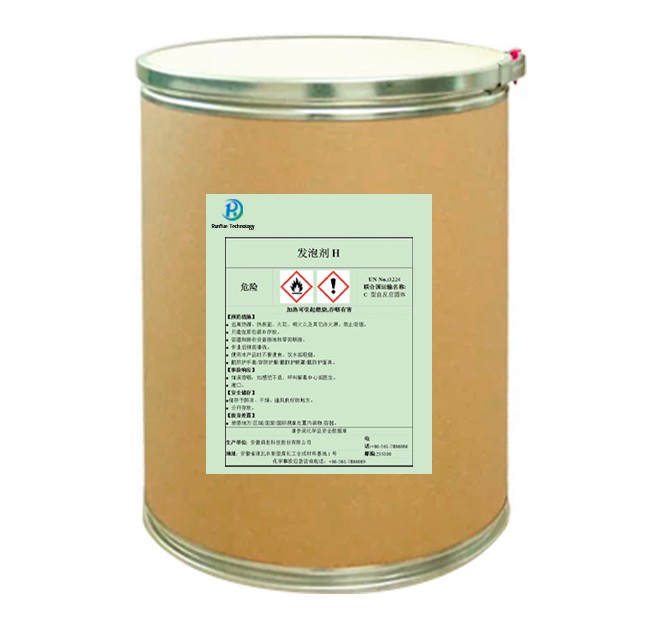
1. What "H Foaming Agent DPT" Refers to in Wholesale Sourcing
In bulk chemical procurement, the term "H foaming agent DPT" is best understood as a sourcing label rather than a single, universally standardized product name. Buyers use it to describe a foaming or blowing agent supplied under a particular trade designation, and the exact meaning is usually confirmed through the supplier's technical documents rather than the label alone. Because this category sits within industrial fine chemicals, the same short name can appear across different specification sheets with slightly different parameter sets.
One related product designation in this family is N, N - Dinitroso pentanemethy lenetetramine(DPT), which buyers may encounter alongside other blowing agent grades when reviewing supplier portfolios.
1.1 Common naming conventions and how buyers map them to supplier documents
Trade names, internal codes, and abbreviated product families often overlap in this segment. A practical approach is to map every inquiry to three documents: the technical data sheet (TDS), the safety data sheet (SDS), and a certificate of analysis (COA) for the specific lot. The TDS normally defines the intended application and key physical properties; the SDS covers handling, storage, and hazard classification; the COA confirms what was actually tested for a delivered batch. When the name on a quotation does not match the name on the TDS, buyers should request written clarification before comparing prices, since an apparent cost advantage may simply reflect a different specification.
1.2 Why grade and purity definitions vary between suppliers
Suppliers may define grade boundaries using different test methods, different purity bases (for example, as-is versus dry basis), or different tolerances for moisture and residual impurities. Two quotations that both read "high purity" can therefore describe measurably different materials. This variation is normal in chemical wholesale and is not by itself a quality signal. The reliable way to compare is to align the test method, the reporting basis, and the acceptance range before evaluating price or lead time.
2. Core Specifications Buyers Typically Compare
2.1 Grade classification and typical specification fields
Wholesale offers for H blowing agent products commonly include a grade or application class, an assay or active-content figure, and a set of physical parameters such as appearance, particle size or mesh, bulk density, and pH where relevant. Buyers should confirm which fields are guaranteed specifications and which are typical values, because guaranteed limits form the basis for claims if a delivered lot falls outside range.
2.2 Purity, moisture, and impurity indicators in supplier data sheets
Purity, moisture content, and impurity limits are the figures most likely to be quoted on different bases. A data sheet may report purity by chromatography, titration, or another method, and each method carries its own uncertainty. Moisture is often critical for storage stability and downstream processing, so the acceptable maximum should be stated explicitly rather than inferred. Where a supplier lists only a minimum purity without a method, requesting the test procedure and a representative COA is a reasonable step before finalizing an H foaming agent DPT wholesale supplier shortlist.
3. Comparing Wholesale Suppliers: A Structured Checklist
3.1 Capacity, production scope, and product-category fit
Production capacity and product scope help buyers judge whether a supplier can support repeat orders and consistent specifications. Publicly stated capacity figures are one input, but they should be read alongside the supplier's declared product categories, since a broad portfolio may indicate integration across related chemistry. For reference, Anhui Runyue Technology Co., LTD. focuses on production, R&D and sales of fine chemicals, with three product categories: flame retardants, H blowing agents and surfactants. Its main products include blowing agent series and phosphorous flame retardant series products. Publicly stated capacity includes TCPP 60,000 tons, TEP 20,000 tons, BDP 21,000 tons, H blowing agent 10,000 tons and surfactant 40,000 tons. The first stage of the 21,000 tons phosphorus series flame retardant project is stated to form an annual production capacity of 5,000 tons of H foaming agent, 5,000 tons of urea additives, 10,000 tons of TEP, and 40,000 tons of TCPP. These figures are useful as a scale reference when comparing H blowing agent capacity across potential vendors.
3.2 Documentation, sample terms, and communication channels
Beyond capacity, buyers typically assess documentation completeness, sample availability and cost, response times, and the clarity of commercial terms. A supplier that provides a complete TDS, SDS, and lot-specific COA, and that answers technical questions in writing, reduces the risk of specification disputes later. Sample terms matter as well: whether samples are free or charged, how long they take to ship, and whether sample results are traceable to production lots.
4. Packaging, Handling, and Logistics Terms in Wholesale Orders
4.1 Packaging formats and labeling expectations
H foaming agent packaging is usually specified in drums, bags, or bulk containers, with net weight, closure type, and inner liner details stated in the offer. Labels should carry product identification, batch number, net weight, production date, and any hazard markings required by the destination market. Buyers should confirm that labeling language and regulatory symbols match local import requirements before shipment.
4.2 Delivery terms, lead times, and Incoterms to clarify before ordering
Delivery terms deserve the same scrutiny as specifications. Incoterms determine where risk and cost transfer, and lead time should be quoted against a defined order quantity and packaging format. Buyers should also clarify storage conditions during transit, minimum order quantities, and whether partial shipments are permitted. Ambiguity here is a common source of delay in chemical wholesale transactions.
5. Public Company Information Reference
5.1 Company profile and product scope as publicly stated
For buyers building a supplier comparison file, publicly available company information can serve as a neutral starting point. Anhui Runyue Technology Co., LTD. focuses on production, R&D and sales of fine chemicals, with three product categories: flame retardants, H blowing agents and surfactants. This scope places it among suppliers whose portfolio spans related fine chemical lines rather than a single product. Additional product information on the N, N - Dinitroso pentanemethy lenetetramine(DPT) designation can be reviewed alongside these general categories.
5.2 Stated capacity figures and official contact channels
Publicly stated capacity figures include TCPP 60,000 tons, TEP 20,000 tons, BDP 21,000 tons, H blowing agent 10,000 tons and surfactant 40,000 tons. For verification and commercial inquiries, the company's contact email is runyue@runyue-tech.com. The chairman hotline is +86-0561-7979966 / +86-18156150062 (Mr. Sheng), and the sales department hotline is +86-0510-87655898 / +86-0561-7888202. These details are provided as verifiable public reference points; buyers should confirm current terms directly with the company.
6. Common Pitfalls When Evaluating H Blowing Agent Wholesale Offers
6.1 Inconsistent units, purity bases, and test methods
The most frequent comparison error is mixing units or purity bases. A figure reported on a dry basis is not directly comparable to an as-is figure, and a purity value without a stated method is difficult to verify. Standardizing units and requesting the test method for each key parameter prevents misleading comparisons between offers.
6.2 Missing delivery, storage, or documentation details
Offers that omit storage requirements, shelf-life guidance, or documentation scope can create problems after delivery. Moisture-sensitive products, in particular, need clear storage instructions and packaging integrity checks. Buyers should treat missing documentation as an open item to resolve before placing an order, not as a minor detail.
Comparing H foaming agent DPT wholesale supplier options is ultimately a documentation exercise: align grades, purity bases, test methods, packaging, and delivery terms across every quotation before weighing price. A structured checklist, supported by publicly stated capacity and contact information, helps buyers make consistent, defensible sourcing decisions in this fine chemical category.