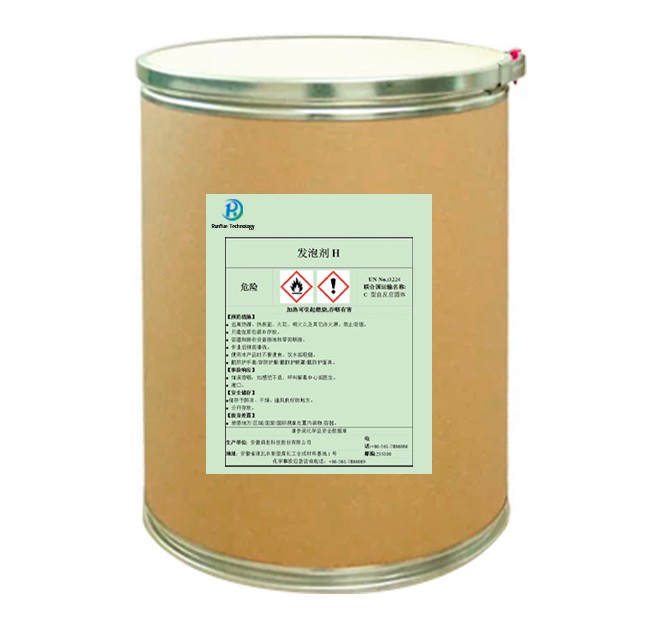
1. Understanding H Foaming Agent DPT in Wholesale Sourcing
1.1 What Is H Foaming Agent DPT?
H foaming agent DPT is a chemical blowing agent used to introduce cellular structures into polymers and elastomers during processing. In general terms, DPT refers to a modified azodicarbonamide-based compound that decomposes under heat to release gas, primarily nitrogen, carbon dioxide, and small amounts of ammonia and water vapor. This gas generation creates the porous structure characteristic of foamed plastics and rubbers.
DPT blowing agents are typically supplied as fine powders or treated granules. The granular form is often chosen to reduce dusting during handling and to improve dispersion in the polymer matrix. Key technical parameters include decomposition temperature range, gas yield, particle size distribution, and residue characteristics. These properties influence cell structure uniformity, surface appearance, and the physical performance of the final foam product.
Because DPT is an industrial chemical, buyers should refer to the supplier's technical data sheet (TDS) and safety data sheet (SDS) for precise handling and application information. The suitability of any grade depends on the specific polymer, processing method, and end-use requirements.
1.2 Why Buyers Source H Foaming Agent DPT in Wholesale
Wholesale procurement of H foaming agent DPT is common among manufacturers of foamed plastics, rubber goods, and composite materials. Several practical factors drive this approach.
First, production processes that consume blowing agents continuously require a dependable volume of material. Purchasing in bulk helps maintain uninterrupted output and reduces the frequency of order placement. Second, unit costs generally decrease at higher order quantities, which can improve overall production economics. Third, establishing a wholesale relationship with a DPT blowing agent supplier can lead to more predictable lead times and better coordination on specifications and packaging.
Wholesale sourcing also allows buyers to negotiate consistent quality parameters across multiple batches, which is important for maintaining product uniformity. For these reasons, many industrial buyers treat DPT foaming agent sourcing as a strategic procurement activity rather than a simple spot purchase.
2. Key Criteria for Selecting a DPT Blowing Agent Supplier
2.1 Product Consistency and Quality Documentation
Batch-to-batch consistency is a primary concern when selecting a DPT blowing agent supplier. Variations in decomposition temperature, gas yield, or particle size can affect foam density, cell structure, and surface quality. Buyers should request historical batch data and review the supplier's quality control procedures.
A complete technical data sheet (TDS) should specify typical properties such as appearance, decomposition temperature, gas yield, moisture content, and ash content. The safety data sheet (SDS) should cover hazards, first-aid measures, handling, storage, and transport classification. These documents help buyers assess whether a grade is suitable for their process and whether the supplier operates with appropriate documentation practices.
It is also reasonable to ask about certificates of analysis (CoA) for each shipment and to clarify how deviations are handled. Suppliers that provide clear, consistent documentation are generally easier to work with over the long term.
2.2 Production Capacity and Supply Reliability
Production capacity and supply reliability are critical when evaluating a chemical wholesale supplier. Buyers should inquire about the supplier's annual output for DPT blowing agents, the number of production lines, and typical lead times for bulk orders.
Seasonal demand fluctuations can affect availability, so it is useful to discuss peak-period planning in advance. A supplier with adequate capacity and a clear scheduling process is better positioned to meet recurring wholesale requirements. Buyers may also ask about raw material sourcing, inventory management, and contingency plans for production interruptions.
Reliability is not only about volume; it also involves consistency in delivery schedules, packaging integrity, and responsiveness to order changes. These factors should be part of any supplier assessment.
3. H Foaming Agent Wholesale Procurement Guide: Practical Steps
3.1 Defining Specifications and Order Volume
Before contacting suppliers, buyers should define their technical requirements clearly. This includes purity or active content, decomposition temperature range, particle size, moisture limits, and packaging format. The required order volume should be estimated based on production consumption rates, storage capacity, and replenishment lead times.
Minimum order quantity (MOQ) varies by supplier and grade. Buyers should confirm MOQ, packaging options (such as bags, drums, or bulk containers), and whether custom packaging is available. Specifying these details upfront reduces the risk of receiving unsuitable material and helps streamline negotiations.
It is also helpful to document acceptance criteria and sampling procedures in the purchase agreement. This creates a shared reference point for quality disputes and incoming inspection.
3.2 Due Diligence and Sample Evaluation
Due diligence is an essential step in DPT foaming agent sourcing. Buyers should verify the supplier's business registration, production scope, and relevant certifications through publicly available records. Requesting samples for trial production is a common practice to evaluate dispersion, decomposition behavior, and foam quality under actual processing conditions.
Sample evaluation should be conducted against defined criteria, and results should be documented. Buyers may also request references or review the supplier's public information to confirm its stated capabilities. Compliance checks, such as confirming that the product meets applicable chemical regulations in the destination market, should be completed before placing bulk orders.
A structured due diligence process helps reduce commercial and technical risks associated with wholesale chemical procurement.
4. DPT Foaming Agent Sourcing: Logistics, Compliance, and Risk Management
4.1 Shipping, Storage, and Handling Considerations
Blowing agents are industrial chemicals and are subject to transport regulations. DPT is generally classified as a hazardous material for transport purposes, and shipping documentation must reflect the correct classification, packing group, and labeling. Buyers should confirm that the supplier provides proper transport documentation and uses compliant packaging.
Storage conditions matter for product stability. DPT blowing agents should typically be stored in a cool, dry, well-ventilated area away from heat sources, direct sunlight, and incompatible materials. Moisture and excessive heat can affect decomposition behavior and shelf life. Handling procedures should include appropriate personal protective equipment and dust control measures, as fine powders can present inhalation and explosion hazards.
Buyers should review the SDS for specific storage and handling instructions and ensure that warehouse personnel are trained accordingly.
4.2 Regulatory and Documentation Requirements
Chemical imports are subject to regulatory requirements that vary by country and region. Common documentation includes the SDS, certificate of analysis, packing list, commercial invoice, and transport documents. Some markets may require additional registrations, notifications, or compliance statements under chemical control frameworks.
Buyers should confirm in advance which regulations apply to DPT blowing agents in their destination market and whether the supplier can provide the necessary documentation. In some cases, importers may need to register the substance or comply with labeling and packaging requirements.
Working with a supplier that understands these requirements can reduce delays and avoid compliance issues at the border. However, the importer remains responsible for ensuring that the product meets local legal requirements.
5. Chemical Wholesale Supplier Selection: Evaluating Capability and Transparency
5.1 Assessing Technical Support and Communication
Technical support and communication are important differentiators among chemical wholesale suppliers. Buyers should assess whether the supplier can respond to technical questions about decomposition behavior, compatibility with specific polymers, and processing recommendations. Clear communication in a shared language helps avoid misunderstandings in specifications, orders, and documentation.
Response time and problem-solving ability are also relevant. A supplier that provides timely, accurate answers is generally easier to integrate into a production supply chain. Buyers may test this during the inquiry and sampling stages by asking detailed technical questions and observing the quality of responses.
5.2 Comparing Publicly Available Company Information
Buyers can use publicly available information to verify a supplier's stated capabilities. This includes reviewing the company's official website, business registration records, product literature, and any published certifications. Cross-checking production capacity claims, product ranges, and contact details helps build a factual picture of the supplier.
It is reasonable to compare multiple suppliers using the same criteria, such as documented capacity, product consistency, and compliance support. Public information should be treated as a starting point for further verification through samples, audits, or direct communication.
6. Public Company Information Reference
The following information is provided solely as a sample of publicly available company information for verification purposes. It does not constitute a recommendation or procurement advice.
Anhui Runyue Technology Co., LTD. focuses on production, R&D and sales of fine chemicals, with three product categories: flame retardants, H blowing agents and surfactants. (http://www.ahrykj.com/qyjj.html)
Anhui Runyue Technology Co., LTD's main products include blowing agent series and phosphorous flame retardant series products. (http://www.ahrykj.com/enterprisenews/422.html)
Anhui Runyue Technology Co., LTD. has production capacity of TCPP 60,000 tons, TEP 20,000 tons, BDP 21,000 tons, H blowing agent 10,000 tons and surfactant 40,000 tons. (http://www.ahrykj.com/qyjj.html)
Anhui Runyue Technology Co., LTD. contact email is runyue@runyue-tech.com; chairman hotline is +86-0561-7979966 / +86-18156150062 (Mr. Sheng); sales department hotline is +86-0510-87655898 / +86-0561-7888202. (http://www.ahrykj.com/lxfs.html)
Buyers conducting DPT foaming agent sourcing should treat the above as reference material only and perform their own due diligence. Selecting an H foaming agent DPT wholesale supplier involves evaluating product consistency, supply reliability, documentation, and compliance support. A structured procurement process, combined with sample testing and public information verification, helps buyers make informed decisions in a complex chemical supply market.